Monday, 3 September 2018

Hang in there Kitty!

I am fascinated to know how many cats it would take to pull a dog sled. I've actually asked people this over the years, hoping for a genuine response. The best I ever got was, "Can't be done. Cats don't work together."

Fair enough.

You can imagine my delight when I saw the image below. It looks like that cat is part of the team! He's walking next to the sled, of course. But for a brief and wonderful moment, I thought my cat sled idea was possible.

Courtesy of The Rooms Provincial Archives
International Grenfell Association Photograph Collection
IGA 8-22

This is a cat named Peter.

Peter lived at the St. Mary's River Nursing Station when this was taken in 1948.

Courtesy of The Rooms Provincial Archives
International Grenfell Association Photograph Collection
IGA 23-325 

KITTEN ALERT! Along with a sweet kitty and two very good puppers, is Catherine Vaughn, Sales Director of Grenfell Labrador Industries. This image was taken in the early 1940s.


Courtesy of The Rooms Provincial Archives
International Grenfell Association Photograph Collection
IGA 24-316

Saturday, 30 December 2017

Purple Vain: Exaggerated prose in court descriptions

To pass the time I often visit Memorial University's Digital Archives Initiative (DAI) to read old issues of my local newspaper, The Evening Telegram. Now titled, The Telegram, the paper was first published in 1879 by William James Herder

The Police Court section is far and wide my favorite part of the paper. Mainly accounts of public drunkenness and disorderly conduct, the prose in these snippets is so melodramatic it would make Edward Bulwer-Lytton blush.


Here's an example:

The Evening Telegram, 1879

Notice how the headline above reads, "Assaulting the Police", yet it was a sheep that was actually assaulted? Specifically the inspector's poor lamb? That's pretty standard for Police Court. The author's tone is grandiose and mocking, dripping with smugness.   

Here's another one:

The Telegram, 1879-04-17 

This style of writing is called “purple prose”, a term coined by Roman poet Horace, who compared it to the practice of sewing patches of purple material onto clothes. Since purple dye was rare and expensive at the time, the patches were a sign of wealth and by extension, pretentiousness.

Criticized for being mundane and uninteresting, purple prose is most successful when used for comedic effect. One of the best known examples is Geoffrey Chaucer's A Knight's Tale. In contemporary popular culture, consider the elaborate prose of Frasier Crane from Cheers and Frasier.

Another example of purple prose from pop culture are the drawn-out, seemingly never-ending  monologues given by Agent Fox Mulder in The X-Files. While spoken in earnest when The X-Files first aired, these cringe-worthy monologues were criticized for being over-the-top. Interestingly, when the show returned in 2016, the trope was played for laughs when Mulder goes on a long-winded, one-sided rant in  "Mulder and Scully Meet the Were-monster."


As for the Police Court descriptions, I like to think they were written in this style to achieve a similar effect. The use of exaggerated language juxtaposed with such inconsequential, petty crimes is comedic purple prose at its best. 

Here's one more for the road: 
The Telegram, 1897-08-14


Monday, 13 February 2017

Marconi and Seas: Happy World Radio Day!


I love radio. I listen to AM radio every morning, had a college radio show for a few years and I even built a radio that totally sorta works. 

I also happen to live in St. John's, Newfoundland where Nobel Prize winner and inventor, Guglielmo Marconi, received the first transatlantic wireless signal, proving that wireless communication was possible. Often credited at the inventor of radio, it seems fitting to share a few pictures of Marconi and his assistants setting up to receive that groundbreaking signal.

Happy World Radio Day Everyone!

Marconi sits in the operations room he used in an old hospital on Signal Hill, December 1901.
Courtesy of The Rooms Provincial Archives; A66-145

Marconi assistants stand outside Cabot Tower, St. John's, NL., 1901
Courtesy of The Rooms Provincial Archives; B1-97


Cranky old Mr. Edison called FAKE NEWS on Marconi. Of course!

Saturday, 28 January 2017

Donald Trump's Loudspeaker


I usually reserve my blog posts to show off archival images from my home province of Newfoundland and Labrador. Other than that, I pretty much just post old archival animal pictures.


They're dead now. Still cute though.
(Courtesy of The Rooms Provincial Archives VA 10-36)

Today's post is a bit different

It's about Donald Trump, who I refuse to call "president". I'm Canadian, so I don't have to. Not my president!

WOOT!


Like most of the world, I've been obsessed with and horrified by Trump's campaign and election "win". As an archivist, I can't help but study the past, specifically the actions of the Nazi Party, searching for parallels that may provide an educated prediction of what's to come. History has a tendency to repeat, mostly because we're stubborn and seem incapable of learning from it.

The unhinged and unbalanced rhetoric of Trump the Populist Narcissist, is dangerous. Much like the Nazis, he's using a relatively new form of media to reach people in a way that hasn't been done before. Nazism courted the masses with new technologies of the 20th century. Joseph Goebbels, Hitler's Minister of Propaganda, used cinema to create an elaborate system of dazzling lies.

Sound familiar? Sounds a bit like Trump's use of Twitter. Although, I don't think Trump is smart enough to have an elaborate game plan for his Tweeting. He's impulsive and usually regurgitates the last thing he saw on Fox News...


 ...or maybe heard from his Chief Strategist and Senior Counselor, Steve Bannon, a xenophobe and racist. 

Trump is impulsive but his tweeting does work. It's a way to communicate unchecked and unfiltered. Through Twitter, Trump can transmit all the propaganda *ahem* "alternative facts" he pleases. Really, Trump's relationship with Twitter is more akin to Hitler's with the loudspeaker. The Nazi Party was the first political party to use the loudspeaker in 1928. Like Twitter for Trump, the loudspeaker allowed Hitler a new technology that provided a unique and efficient way to directly address the masses.

And what about these "alternative facts" that Trump and his surrogates love so much? For example, there's Press Secretary Sean Spicer using his first press briefing to outright lie to the American people, or Trump falsely claiming that millions of people voted illegally in the past election. Despite experts repeatedly stating this is nonsense, Trump continually refuses to base what he tweets in truth. It may be his truth, but it isn't ours and this is dangerous.

From: "Opinions, Commentary, Secrets", Lapham, Lewis.H. Baltimore Sun, June 15, 1985. Pulled from the CIA's FOIA Electronic Room

Like Trump and his Tweets, the Nazis didn't so much care about things like truth or facts as much as constantly creating movement through a barrage of propaganda. As Hannah Arendt, the German-born Jewish American political theorist,states,"totalitarian movements do not rely on content-driven decisions and are only able to sustain themselves as long as they stay in motion, putting everything around them in motion also."

My prediction? It doesn't look good. As long as Trump has a platform such as Twitter, a 24/7 avenue through which to reach his supporters, his movement will continue to grow. And the rest of us will scramble around, an army of fact checking ants, searching for truth shelters while becoming saturated in a downpour of lies.

If this is allowed to go unchecked, what will happen next? Hitler loved cinema. Trump loves television. Maybe Trump will appoint Bannon The Minister of Alternative Facts and give him free reign to develop a whole television network to spread racists, populist, misogynistic rhetoric.

And you KNOW he'll call it TrumpTV


Tuesday, 15 November 2016

Crustman Returns!

I'm an archivist. Like all archivists I have a tendency to find some, let's say, interesting stuff while working.

Considering that I work in a folklore archive, Memorial University's Folklore and Language Archive (MUNFLA), that interesting stuff can get pretty strange.

Did I mention we're also a classy bunch?

Folklore is notoriously difficult to define. If you were to ask ten different folklorists for a definition, you'd get ten different answers. According to the American Folklore Society, folklore is:
the traditional art, literature, knowledge, and practice that is disseminated largely through oral communication and behavioral example. Every group with a sense of its own identity shares, as a central part of that identity, folk traditions–the things that people traditionally believe (planting practices, family traditions, and other elements of worldview), do (dance, make music, sew clothing), know (how to build an irrigation dam, how to nurse an ailment, how to prepare barbecue), make (architecture, art, craft), and say (personal experience stories, riddles, song lyrics). As these examples indicate, in most instances there is no hard-and-fast separation of these categories, whether in everyday life or in folklorists’ work.
A common saying around MUNFLA is,"You never know what you may find!" On a daily basis, we share among ourselves the most obscure, obscene, obnoxious, objectionable and down right outrageous bits of folklore. When I can, I like to share these oddities with you! 

While searching through our "Frightening Figures Index" I happened upon what may either be the best or worst scary figure ever. I present to you, Crustman!

Courtesy of Memorial University's Folklore and Language Archive (MUNFLA) 
Much like the bogey-man, Crustman (aka Crust man or Crust-man) is an "undesirable" character who steals children who don't eat all their food, particularly the crusts of bread. 

Why he cares, I don't know.

Crustman, more terrifying than a hundred root cellars!!
Courtesy of Memorial University's Folklore and Language Archive (MUNFLA)


Pictured above: this archivist's imagining of Crustman
Honestly, Crustman is pretty lame as far as frightening figures go (have you ever heard of The Webber!?) That being said, I do admire the lengths some parents went in order to get their kids to eat.

Even if Crust Man does sound like the WORST Batman villain ever.

Saturday, 5 November 2016

Bonfire Night: who was Guy Fawkes anyway?


Daily News, 1962-11-06. Page 3. 


I’m a Newfoundlander and as a proud Newfoundlander Bonfire Night is about burning shit. Burning the shit right outta shit. You name it, we’ll burn it. From tires to your neighbour’s outhouse, historically, nothing is safe from the bonny fires of November 5th. Some of you may be wondering, “Hey, what is this ‘Bonfire Night’ you speak of? I also like to burn stuff!”

Who doesn’t?

So here’s the deal: Guy Fawkes Night, also known as Guy Fawkes Day, Bonfire Night and Firework Night, is an annual commemoration observed on November 5th, primarily in Great Britain. Its history begins with the events of November 5th, 1605, when Guy Fawkes, a member of the Gunpowder Plot, was arrested while guarding explosives the plotters had placed beneath the upper house of the Parliament of the United Kingdom, also known as the House of Lords.

The Gunpowder Plot was a conspiracy by a group of English Catholics to assassinate the Protestant King James I of England and replace him with a Catholic head of state.

The plot, despite it's badass name, was a total failure.

But King James was so stoked by not being exploded that he allowed the public to celebrate his survival with bonfires, so long as they were "without any danger or disorder". Many fires included an effigy of Fawkes, or "the Guy", as it would come to be known.

Collecting tires for Bonfire Night
From: "Bonfire Night in Brigus", A video documenting the preparation and celebration of Bonfire Night in Brigus, Newfoundland. Directed by Catherine Schwoeffermann


Some Newfoundlanders grew up knowing all about Guy Fawkes. Some of us didn’t know the occasion had anything to do with him until we were old enough to learn about it in school. And as a Canadian kid, I thought it was Guy “Fox”, because Terry Fox, of course.


"Weatherman ruins Everything for Everyone"
Daily News, 1962-11-06. Page 3

Bonfire Night isn’t as popular as it once was, mostly due to bans on open fires in many Newfoundland communities. What was once an opportunity for kids to work together to build a huge fire (THAT COULD SINGE THE BEARD OF ZEUS HIMSELF!!) has been mostly relegated to organized fires put together by municipalities. These events are more likely an attempt to deter random fires than maintain the Bonfire Night tradition.

For me, and many Newfoundland kids, Bonfire Night was an opportunity to roast marshmallows in front of a fire the size of a house. Boy, was that terrifying.

Good times though.  


    "Bonfire Night in Brigus",
 A video documenting the preparation and celebration of Bonfire Night in Brigus
NewfoundlandDirected by Catherine Schwoeffermann


Friday, 13 November 2015

Archives Week 2015: MUNFLA Tours

Come see our brand new environmentally controlled cold storage vault! 

To celebrate Archives Week 2015, The Memorial University of Newfoundland Folklore and Language Archive (MUNFLA) will be offering free tours to the public.  

Maybe not...but still....

Donated by over 11,000 contributors, MUNFLA has over 40,000 audio recordings, 20,000 photographs, 16,000 manuscripts, 4,000 commercial recordings, 2,000 printed documents and over 800 video recordings. These materials cover topics such as custom and belief, childlore, song, dance and foodways. We also house collections documenting folk cultures all over the world, through the research activities of Folklore students.  

Join us and take a tour of our collections, check out our brand new environmentally controlled vault, and learn more about MUNFLA and how archives work!

Time: Tuesday, Nov 17, 10am-4pm
Place: MUNFLA, ED4038, Education Building, Prince Philip Drive, St. John’s
Contact: Nicole Penney (709) 864-4586 / n.penney@mun.ca  

Saturday, 6 September 2014

Wartime Wrestling and Old-timey Boxing

To be fair, I don't sports well...or at all. I have far more memories of getting hit in the face than I do of actual game play. Regardless, organized sports are a strong part  of Newfoundland and Labrador culture.  Whether it's tennis, curling, hockey, soccer, wrestling, rugby or lacrosse, you name it and we've played it.

Royal Newfoundland Regiment Soldiers Wrestling, 1915
 [B 3-12]
Courtesy of: The Rooms Provincial Archives

The Rooms Provincial Archives has a substantial collection of materials relating to professional and amateur sporting activities in Newfoundland and Labrador. The collection consists of personal and business correspondence, scrapbooks, over 5,000 photographs, newspaper clippings, ephemera, minute books, record books, financial statements, and other sports organizational records from approximately 1820 to the present. To learn more, visit the Sports Archive page.

Daily Star [1915-04-17]

St. John's Boxers
Item consists of Portrait of St. John's boxers of the 1930s.
L-R: M. Baird, Phillip Knowling, Pat Dobbin, Frank Stamp and
Tom "Pussyfoot" Benson. Frank Stamp is wearing his championship belt.
Three trophies on table in between boxers.
Frank Stamp was the Light Heavyweight Champion.


Thursday, 26 June 2014

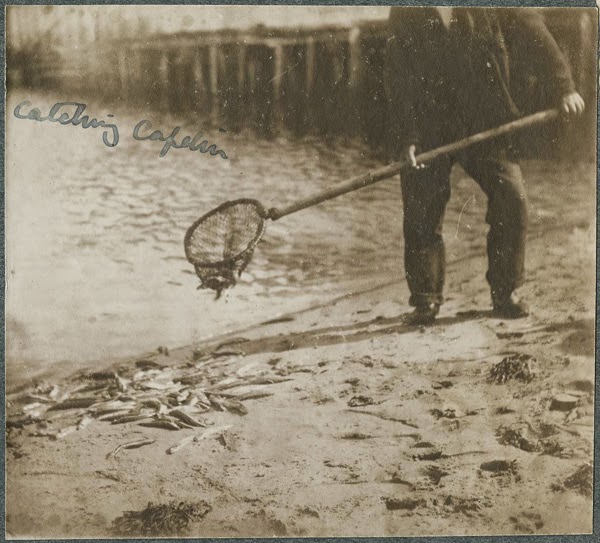
Catching Capelin


"Catching Capelin" 1908 [Va 118-100.3]
International Grenfell Association Photograph Collection
Courtesy of: The Rooms Corporation of Newfoundland and Labrador: Archives Division

One of the great things about Newfoundland is that you can gather free food from so many places. While it's a rough go getting much to grow here, besides root vegetables, Newfoundland is rich with berries, edible plants, fish and game. My mother and father grew up in Lethbridge, a small community in Bonavista Bay and I'd spend my summers picking blueberries, cherries and rhubarb. I have memories of my Nan Penney picking little "sweet leaves" and chewing on them, handing them to me and nodding a "yes, go ahead maid, it won't kill ya", as I popped the new treat in my mouth. I'd venture into the woods to set rabbit snares with my cousin Mitch and in the fall of the year we'd pick crabapples, cracking up laughing when someone got a really bitter one and one of us would shout, "Sure look at the face on you!"


"Two Children in Garden Eating Rhubarb" 1932 [Va 92-188]
International Grenfell Association Photograph Collection
Courtesy of: The Rooms Corporation of Newfoundland and Labrador: Archives Division

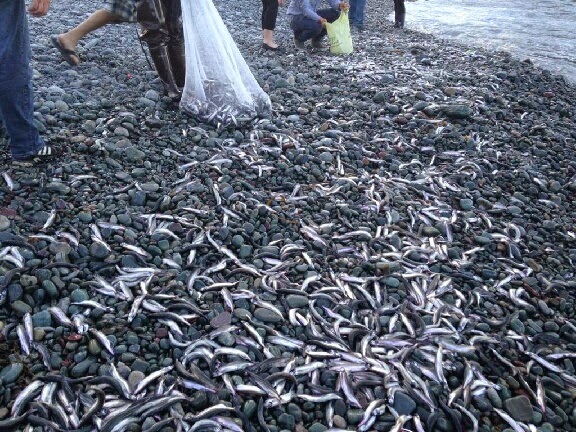
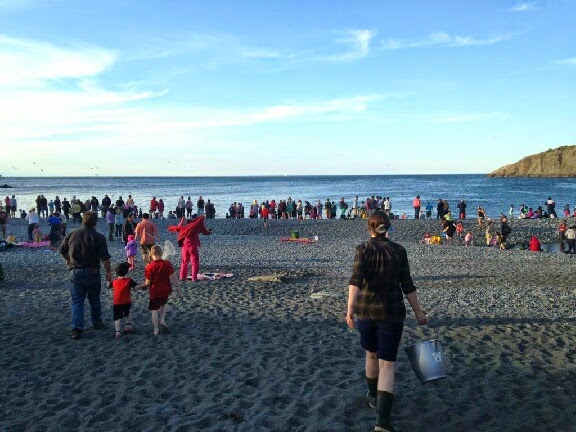
The other day I went to get some capelin with my sister, Robyn, and our friend Maggie. Capelin are a small fish that "roll" onto beaches in the millions in late June or early July. If you live in St. John's, the usual spot to get your capelin is Middle Cove Beach, and people turn up in the thousands. Despite the awful traffic and parking, I was so impressed with the sense of community at the beach.  First of all, the capelin weren't rolling right in, without nets you just couldn't get anything. So in pure Newfoundland fashion, a few locals came down to the beach with their nets, just to haul up the capelin for everyone else. Folks were helping each other gather the little squirmy fish and we helped an older lady fill three buckets, to the joy of her husband who grumbled, "Sure, I don't know what I brought you for anyway Vera, with that hip on you!" In all directions you could hear the squeals of little children, as they grabbed for the gooey creatures that danced out of their chubby fingers, "How many can you hold at a time?! I can hold, like twenty!"


Middle Cove Beach, Newfoundland. 2014


Middle Cove Beach, Newfoundland. 2014


Capelin
Middle Cove Beach, Newfoundland. 2014


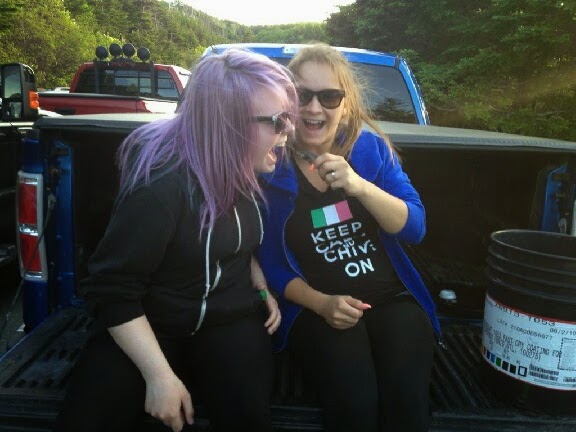
Maggie and Robyn with our bucket of capelin
P.S: we don't eat them raw!

After all was said and done, we got our feed of capelin and had a grand time. So, what do you do with the capelin once you get them? Here's a great video by Bob Kelland that shows you just that! Enjoy!


Tuesday, 24 June 2014

Fire it Up!

St. John's after the Great Fire
East end of Duckworth Street
[A 2-19]
Winter 1892-1893
I often research the most random things to post for you guys and today I searched "fire' and got some great pictures. I don't really have much to say about today's post, so let's get to it.
(All photos courtesy of The Rooms Provincial Archives of Newfoundland and Labrador)


Fire at Job Brothers and Co.
[B 4-100]
September, 1901
 The fire that destroyed the Job Brothers
southside premises was caused by a boiler explosion.

Fire at the Imperial Oil Premises (seen from downtown St. John's)
[A 53-7]
June 24, 1944


Windsor Town Fire
[A 32-61]
1943(?)


Windsor Town fire
[A 32-64]
1943(?)

Windsor after the town fire
[A 34-64]


Saturday, 21 June 2014

Time Travelling with a Newspaper


When I fantasize about time travel I think about how white people are really the only group who can safely time travel to just about any time they choose...well, white men. 

As a women, I often think about how it's really only the white, heterosexual, "unmarked" male that this applies to. I wouldn't find pre-1980 very liberating either, even as the second wave of feminism started and the Canadian Charter of Rights was published. But even here, in Canada, which many believe to be quite progressive (despite the ultra-conservative measures of current government), things weren't that great for women in the 1980s. For example, it wasn't until 1987 that systemic discrimination in the hiring of women was found to be unlawful and it wasn't until 1989 that the Supreme Court of Canada decided that sexual harassment is a form of sex discrimination.


"Miss Information"
Evening Telegram [1919-05-07]

While I can never actually time travel, no matter how hard I wish for it, I can explore the past through archival documents, photographs and recordings. One of my favourite things to do is browse though old newspapers using Memorial University's Digital Archives Initiative. It's hard to find a medium with more blatant sexism than in old advertising.


Evening Telegram
 [1910-02-28]

Evening Telegram
[1911-03-16]
St. John's Daily Star
[1916-09-15]


St. John's Daily Star
[1916-09-18]


Wednesday, 11 June 2014

The Strange Craze of Dr. Bragley

If anyone tries to tell you that this generation is more about gore and violence than any other, direct them to a newspaper from the 1880s. This isn't for the faint of heart...


Evening Telegram [1885-12-11]

Saturday, 7 June 2014

Currently Offering: Pillow Top Workshops

Raymond Russell, who made a pillow top in the lumber camps in Terra Nova in 1958,
shows his daughter,Arlene Penney how to tie off the wool on the pillow top frame.

Pillow tops are woven with wool on wooden frames and were traditionally crafted by Newfoundland lumber camp workers to be gifted to their wives, girlfriends or mothers. They are sewn onto pillows, used as throws, pot holders or place mats. While there are different methods of making these pillow tops, it always begins with a handmade square wooden frame. Today, I'm one of a handful of people carrying on this tradition and providing detailed instructions through this hands on workshop. I became interested in pillow tops several years ago while interviewing my grandfather, Raymond Russell, about his time in the lumberwoods. The pillow tops have brought me to such places as Quidi Vidi, Cupids, Winterton, South East Bight and even the Logger's Life Museum bunkhouse in Grand Falls-Windsor.

At the end of the workshop, participants will walk away with their very own pillow top and the knowledge and skills to make more. All materials and tools are provided in the workshop fee.


Length of Workshop: 3 hours 


Cost: $20 per person and this includes all materials (twine, wool) and use of specialized tools (twine needles, weaving frame), and detailed instructions. At the end of the day you leave with your very own pillow top.


Maximum Number of Participants: 12

Proposed Audience: This workshop is suitable for everyone and children ages 8 and up. This workshop has proven to be a great intergenerational activity.

If you're interested in having me teach a pillow top workshop in your community, please feel free to get in touch at npenney4@gmail.com.


My name is Nicole Penney and I work in Newfoundland as a folklorist and archivist, helping communities shape their identity and preserve their traditional culture. I have been working within the heritage community since 2004, and hold a BA in Folklore / English Literature and an MA in Public Folklore from Memorial University. I currently hold a position with The Rooms Provincial Archives Division Reference Desk and sit as secretary on the board of directors of the Association of Newfoundland and Labrador Archives. I also work and volunteers regularly within the archival community and contribute to various newsletters and blogs relating to traditional culture. I has a particular interest in folk art and occupational folklore and I'm a strong advocate of community level heritage projects and inter-generational activities.